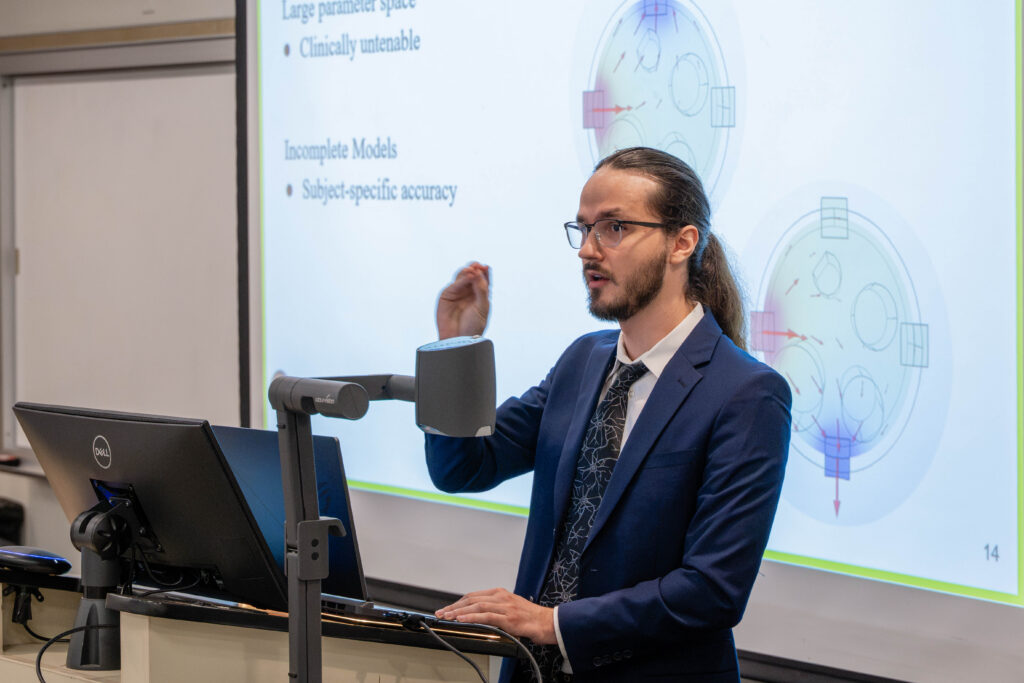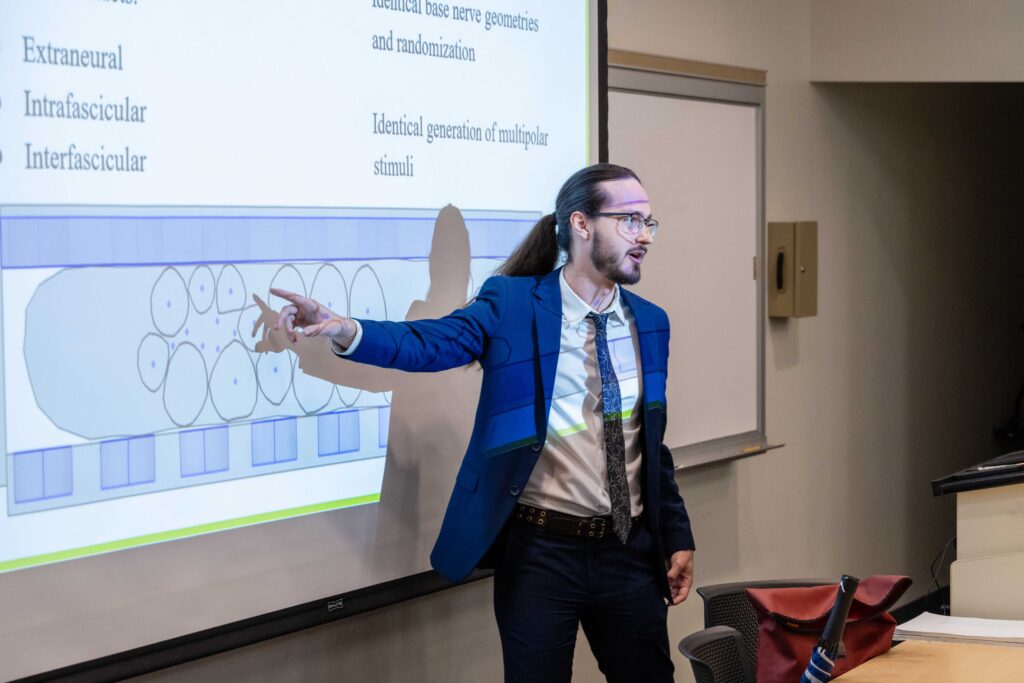
Vlad Marcu defends Ph.D. dissertation
—
Vlad Marcu recently defended his Ph.D. dissertation titled “In Vivo and In Silico Optimization of Selective Multipolar Stimulation With Subject-Specific Models.”
Born in Transylvania, Romania, and raised in Livonia, Mich., Marcu came to Case Western Reserve University after earning his B.S. in Engineering Physics and Electrical Engineering from the University of Michigan. As an undergraduate, Marcu was interested in quantum computing and neuromodulation, but became increasingly interested in biomedical engineering as he took more classes. As a teenager, he enjoyed anime like Ghost in the Shell and was fascinated by articles about artificial organs. When it came time to start graduate studies, he was drawn to CWRU because of the passion he saw in other researchers in Professor Dustin Tyler’s lab. He praised Tyler for “pushing for real, scientific statements and analyses.”
Primarily interested in subject-specific modeling of nerve activation and real-time calculation of control parameters, Marcu’s Ph.D. dissertation on nerve stimulation models demonstrates his deep expertise. He conducted multiple animal experiments, including some with a person with a spinal cord injury, to develop models that do not require imaging, showcasing his practical impact and technical skill. His work integrates computational techniques, machine learning, linear algebra, and differential topology to translate findings into clinical settings and inspires confidence in his capabilities.
Looking back on his time at CWRU, Marcu is most proud of his methods for calculating multipole stimulation currents from his simulation results and of how they bring his undergraduate and graduate studies together. He mathematically defines the voltages a given electrode could apply to a nerve from a combination of events. Then he uses a projection method to calculate currents that can activate a nerve in milliseconds rather than the minutes it used to take. “It was a genuinely original thought that used knowledge I have from all over to solve a problem that a lot of other people have had in a good, principled, generalizable way,” he said. “This method opens up the possibility for researchers to consider a much wider array of possibilities when running simulations because the calculation is so much faster.”
In the coming weeks, Marcu will become a postdoc at Massachusetts General Hospital, where he will work on peripheral nerve models that more accurately reflect MRI-derived activation. In the long term, he hopes to make a high-resolution interface “so that as far as the brain knows, a prosthetic limb or organ might as well be the original.”